
ROCHESTER, Minn. — Congressman Brad Finstad, who has avoided townhalls and news interviews for months, appears in no mood to change course. When invited by Rochester television station KTTC to a sit-down interview in late March, Finstad’s media aide Jenny Luepke said the congressman was busy but she would check his schedule. Her exact words:
“I’m working to find some time to set this up in the Congressman’s schedule. I’ll circle back once I have a better idea of Representative Finstad’s availability and which location works best.”
Still, a month later, Luepke hasn’t followed through.
Shifting political landscape
In normal times, candidates welcome news coverage. But these aren’t normal times. President Trump’s plummeting popularity has spooked the U.S. House GOP leadership. The party strategists fear that Republican incumbents are vulnerable for being lockstep Trump acolytes. This includes Finstad. The House GOP leadership’s campaign advice to candidates seeking re-election: Avoid townhalls and limit constituent contact to small carefully screened groups that won’t press with inconvenient observations and questions that could make for unfriendly news coverage.
Finstad’s Minnesota Problem
A special problem for Minnesota Republicans is Trump’s Operation Metro Surge last winter. The President’s deportation troops took over city streets, mostly in the Twin Cities but also in Finstad’s backyard MN-1 cities like Rochester, Mankato and Winona. Finstad supported Metro Surge. In the end, public opposition in Minnesota humiliated Trump into calling off his troops. Minnesotans, however, have long memories. Finstad has additional problem largely rural MN-1 — a discordance between his background as a farmer and the growing farm crisis that Trump has created with his tariff war and Iran war. Diesel fuel, essential in farming, has soared to prices never seen before. Soaring too are prices for fertilizers, if available at all, because Trump’s Iran war has cut off essential raw ingredients. Farmers are panicking for the now-or-never planting season for 2026 crops.
KTTC’s invitation
KTTC has no reputation for gotcha journalism. In fact, as a courtesy the station’s invitation to Finstad included sample questions:
> What are you hearing from First District farmers?
> How are you directly being impacted by current economic factors?
> Is additional federal assistance for farmers likely?
> Do you support President Donald Trump’s handling of Iran?
> Are you concern about election implications in November?
To be sure, the actual interview would be in the usual televison news format and be likely to meander conversationally into other issues.
Television market
Candidates generally welcome airtime on local newscasts, especially KTTC as the major station in southern Minnesota’s Congressional District 1. The KTTC signal reaches 11 of MN-1’s 20 counties. The KTTC reach includes these population centers: Rochester, population 123,000; Mankato, 44,000; Winona, 26,000; Austin, 26,000; Owatonna, 26,000; and Albert Lee, 18,000. There are 319,000 people total in the Rochester-Austin-Winona standard metropolitan statistical area, a cohort used by economists and by political analysts.
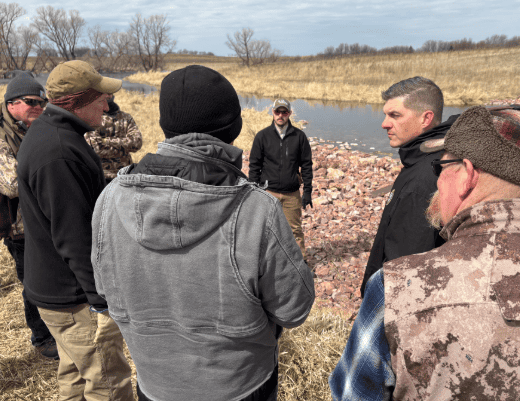
Chatting in the field. Finstad, the man without headgear, creates photo opps like this to suggest being in touch with constituents. These, however, are closed loops, not a meaningful tapping of public opinion. Images: From Finstad’s online scrapbook .
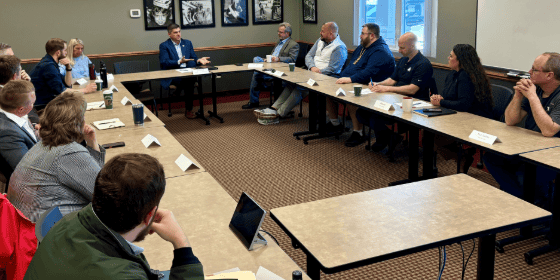
A roundtable. Finstad at head table with a select group screened as friendly and benign. He provides an updates from Washington. More his talking than listening.
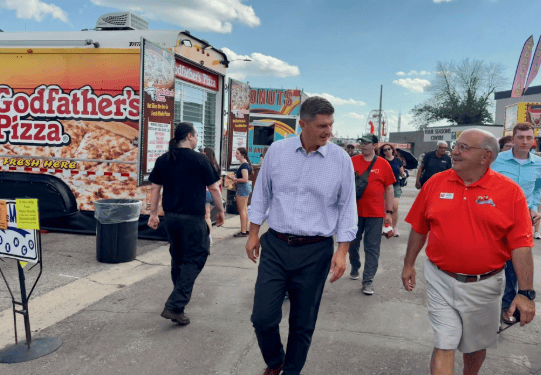
In stride. At the Steele County Fair. A kind of event for 1920s-style politics. Good for kissing babies, not dialogue.
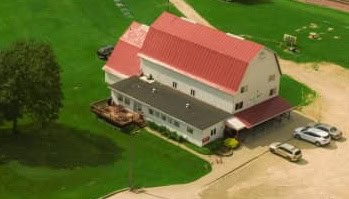
In Lewiston. An invitation-only event at golf club house. No news reporters alerted to attend.
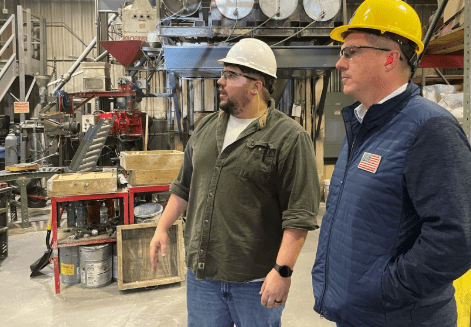
Winona factory visit. In yellow hard hat at Alliant Castings. Although useful to Finstad as a campaign photo, the event was not designed for public dialogue. None occurred.