
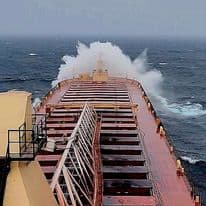
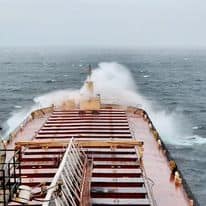
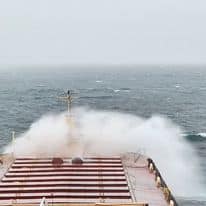
Now you see it. Then you don’t.
A seafarer’s fear: Will open water be more fierce
HUNDER BAY, Ont. – Gale-force winds trashed Lake Superior into a fury that conjured memories of the loss of the storied Edmund Fitzgerald ore-carrier 46 years earlier. The second mate on the tug Joyce L VanEnkevort captured the 2022 fury from the top deck, aiming his camera ahead at the bow of the bug’s barge disappearing in thundering spumes 800 feet ahead. This was 59 miles up the North Shore from Duluth as the articulated tug-barge vessel neared Grand Portage at the Ontario border and prepared to turn across the lake for a 300-mile leg across open water to locks a Sault Ste. Marie.
November 10 remembered
The single-hull Edmund Fitzgerald was launched in 1958. It broke up in a storm on November 10, 1975, and sank in 530 feet with the loss of 29 crew. At 790 feet the Fitzgerald was the largest vessel ever to sink in the Great Lakes. It was immortalized by folk singer Gordon Lightfoot: “For each man on the Edmund Fitzgerald / The legend lives on from the Chippewa on down /Of the big lake they called Gitche Gumee / Superior, they said, never gives up her dead / When the gales of November come early.”
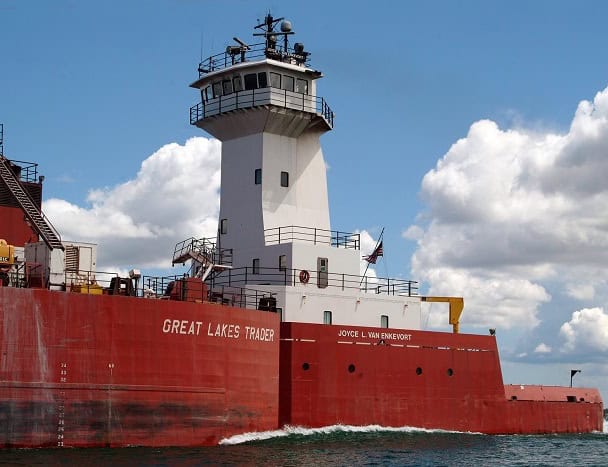
New-style lake carrier. The Joyce L VanEnkevort is a stand-alone tug that usually is married to its barge in an 800-foot two-vessel articulated arrangement. If the barge is sinking, the tug can be disconnected with its crew safe. This is in contrast to single-hull carriers like the doomed Edmund Fitzgerald. The twin-screw Joyce L VanEnkevort tug typically ferries iron ore from Minnesota’s Iron Range to steel mills in Gary, Indiana. The was built in 1999 in Sturgeon Bay, Wisconsin. Home port: Escanaba, Michigan.