
BLACK RVER FALLS, Wis. – An object n the sky, pprobably a meteor, lit up the morning at thousands of miles an hour and exploded at least twice. Then it disappeared, leaving only a white contrail that lasted 30 minutes or so. The American Meteorologial Society, which researches atmospheric phenomena, compiled sightings that suggested the meteor collided with the Earth atmosphere between LaCrosse and Eau Claire, perhaps around Black River Falls. This was at 6:13.m. A golfer in the LaCrosse suburb of Holmen, Andy Beckstom, said the boom took 10 seconds to reach him. Considering the speed of sound at 760 mph, the entry was 50 to 60 miles. There was no way to know how high or how far away. The meteor was seen in northwest Minnesota, northern Wisconsin, southern Iowa and Central Illinois. It was described mostly as a fireball. One person called it as a “a basketball on fire.” No law enforcement agencies received reports of impact on the ground. Of 177 reports to the American Meteor Society,15 people heard the boom.
Perseids showers
The Perseids are a prolific meteor showers associated with the comet Swift-Tittle. They occur mid-July to late August. When orbits of Earth and the comet’s tail intercept, debris enters the atmosphere and burns up from friction. The displays can be spectacular. The meteors are called the Perseids because they appear from the general direction of the constellation Perseus.
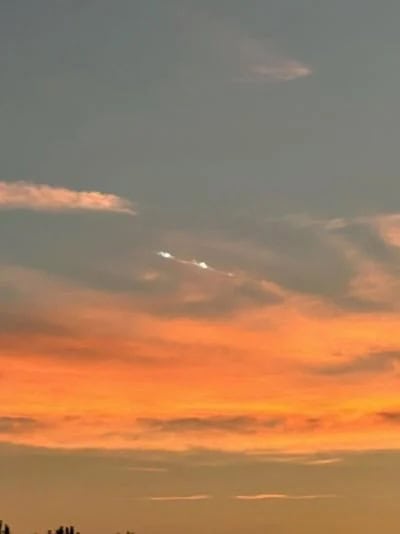
Over northeast Iowa. Dozens of people caught images of the contrail before it dissipated. Image: Randy McLean.
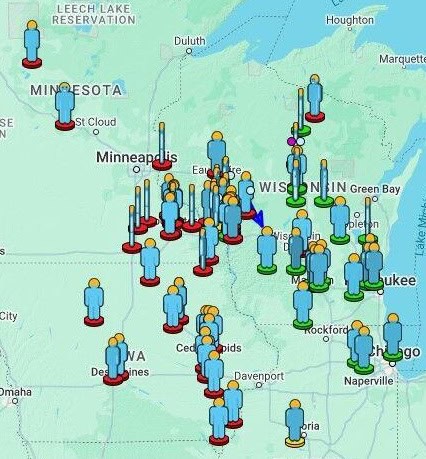
Clues to triangulate. Scientists say the object probably self-immolated and never reached ground. Image: American Meteorological Society
Tiny, brilliant, gone in a flash
Most meteors ae about the size of a grain of sand and almost always disintegrate in a flash. Significant exceptions:
Vedefort crater, 190 miles across, in South Africa, 2 billion years ago.
> Chucxuoub crater. 120 miles across and 12 miles deep, in Yucatan in Mexico, 66 million years ago.
> Sudbury crater. 80 miles across, in Ontario in Canada, 18 billion years ago.
> Beaverhead crater. 37 miles in diameter, in southwest Montana in the United States, probably 600 million years ago.