
ST. CLOUD, Minn. – Republican presidential nominee Donald Trump will have a chance this weekend in St Cloud to clarify his recent attack on Democrat rival Kamala Haris as soft on crime. Trump aides posted an assertion on the media site X last week that in 2020 Harris had donated to a Minnesota group that raised bail money for people accused of a crime. Trump, speaking at a rally in North Carolina, didn’t go quite so far. Trump said that Harris had encouraged donations to the Minnesota Freedom Fund – not that she herself had donated. The distinction between encouraging and donating may seem trivial, but underlying issue is profound: Has the practice jail bail gotten out of hand? Has the judicial system, historically controlled by white people, been used the bail system, perhaps unwittingly, perhaps not, to incarcerate black people? Is this racial discrimination? Trump’s position appears to be: “Lock ‘em up, keep ‘em there.” Harris is nuanced with a social justice perspective. She sees the bail system as a racist tool that needs reform.
A Minnesota bail project
In 2016 a University of Minnesota grad student, Simon Cecil, founded the Minnesota Freedom Fund to raise money to help people pay bail Due to meager resources, the organization initially focused on bails of only $1,000. In 2020 Kamala Harris, then a U.S. senator, went online with others and encouraged donations to Cecil’s fund. Suddenly the Fund had $30 million from 2,000 donors. With the new income, the Fund had successes in high-profile cases. These included the case of a black man, Jaleel Stallings, who was charged with attempted murder. Thus was during the racial unrest after a white police officer choked George Floyd to death. The Fund paid $75,000 cash to get Stallings out of jail on bail. Stallings eventually was acquitted and won $1.5 million as an apology for wrongful arrest. Had Stallings’ bail not been paid, he would have been in jail for months awaiting trial.
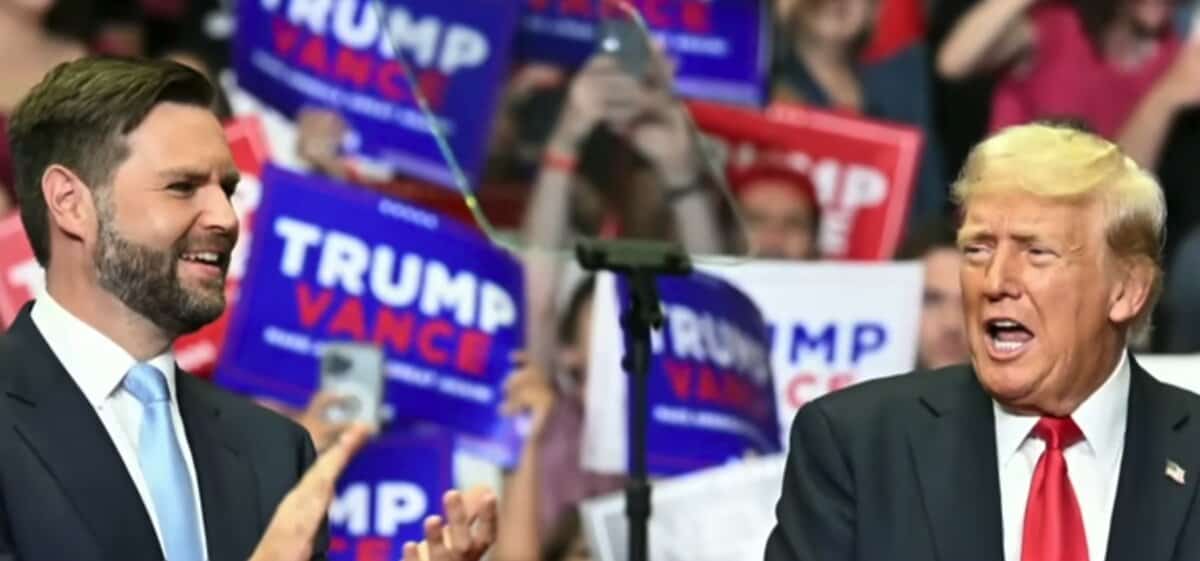
At Republican national convention. Running mates Trump and Vance due in Minnesota this weekend for joint rally in St. Cloud.

Stallings. He was released on $75,000 bail after 2020 Minnesota arrest in which he was accused of shooting at a police officer. The bail money came from a Minnesota organization supported by Kamala Harris out of a commitment to historic misuses of the bail system to keep black men locked up. Stallings evenuually was exonerated and won $1.5 million as an apology for wrongful arrest.
Verbatim
Trump in Charlotte, North Carolina: “One of the dangerous criminals Kamala helped bail out of jail was Shawn Michael Tillman. You know that name. A repeat offender who, with Harris’s help, was set free. He then went on to murder a man on a train platform in St. Paul, Minnesota, shooting him in cold blood six times, lying on the ground.” NOTE: Trump singled out he Tillman case from hundreds, including the Stallings case, in which justice was served by bail assistance.
Verbatim
Harris, in 2020, then a U.S. senator, just after George Floyd’s death: “If you’re able to, chip in now to the @MNFreedomFund to help post bail for those protesting on the ground in Minnesota.”
Trump cherry-picking
In attacking Harris at his North Carolina rally, Trump didn’t mention the Jaleel Stallings case. Trump instead cited the 2022 case of Shawn Michael Tillman. Tillman, a black man, was being held as a suspect in two indecent exposure cases and a sexual misconduct case. He posted bail, apparently with help from the Minnesota Freedom Fund, as a guarantee that he would be return to court for further proceedings – or forfeit the money. While out on bail, Tillman shot and killed a man with whom had a beef while the man was waiting to catch a train. Tillman was arrested again. A jury convicted him. The judge sent him to prison for life. Had Tillman been in jail even on the relatively minor sex crimes, Trump notes the man wouldn’t have been able to commit the murder. His broader conclusion, to be blunt, is simplistic: Jail bail reform? No way. Lock ’em up. Keep them there.
Trump in St. Cloud
A question for Minnesotans is whether Trump will retell his Tillman s tale at a rally scheduled for St. Cloud this weekend. He is appearing with running mate JD Vance. Trump has been inclined over his three presidential campaigns to repeat stump stories even after they’ve been debunked. It’s like they’re ingrained indelibly in his brain and that somehow that makes them true. The Tillman case appears to have been dug up by Trump’s war-room staff without ian internal examination of the goals of the Minnesota Freedom Fund. A source for Trump on the Tillman case may have been a prominent Minnesota Republican, Tom Emmer, now in Congress. Emmer has told the story in his own election campaigns. Emmer, who is white, is a long-term Trump ally and close advisor on campaign tactics.

Emmer’s hand in all this? Tom Emmer, in fifth term Congress from MN-6, north and west of Twin Cities. In tight with Trump.
Trump’s flawed implication
Trump’s post last week said: “Kamala Harris is radically liberal and dangerously incompetent.” With political posts, a certain level of spin it is not unexpected, but the Trump staff’s X post’s implication – with a photo of Harris in laughter — was flat-out misleading. Harris is not soft on crime. Her record as a district attorney in San Francisco is replete with criminal convictions. She also was California’s elected chief legal officer as attorney general with a fierce albeit fair commitment to law and order. To repeat the civics lesson: Bail is a judgement call by a judge and not a conclusion about guilt or innocence – not something determined by district attorneys or attorneys general.
Racism and baiting
It cannot be left unnoted that Trump is white and has a record of racism. This goes back at least to his early career as a New York landlord for racial profiling. Then in 1989 he bought a full-page New York newspaper ad to call for the execution of five black and Hispanic teenagers for a Central Park rape tyat they didn’t commit and for which eventually they were exonerated. Trump never retracted his call for the death penalty nor apologized. In the 2008 presidential campaign, he falsely accused Barack Obama, a black man of mixed race heritage, as being African-born. Trump’s point was dog-whistle racism. In 2024 he’s gone after Harris, who is of black and Asian heritage, again with dog-whistles. A theme in Trump’s three presidential campaigns has been a xenophobic, white supremacist and racist streak that equates black and brown skin with murder, rape, drugs, mental illness and dreaded diseases. These phobic sweeps have extended also to Muslims.
Stallings case facts
On the night of May 30, 2020, Stallings was standing with ither people in a parking lot on Lake Street in St. Paul. This was during the racial unrest following the white police killing of George Floyd, a black man, in nearby Minneapolis. Two shots were fired from a white cargo van that had been cruising the street. Stallings was hit in the chest with what he thought was a bullet. He drew his pistol and fired back at who he thought might be white supremacists that Governor Tim Walz had warned were fanning the flames of protest. Stallings later testified that he purposely missed, aiming low, toward the front of the van, hoping to scare off whoever had shot at him. Suddenly members of a police team piled out of the unmarked van yelling, “Shots fired!” Stallings realized they were police, dropped his gun, and laid face down on the pavement, arms spread-eagle. He had been shot with one of the plastic projectiles the SWAT team had been firing at people out past a curfew. Thinking someone had just tried to shoot them, the officers beat Stallings bloody for 30 seconds and beat and tased his acquaintance. Stallings was hospitalized with a fractured eye socket. Not to his credit, the Hennepin County prosecutor at the time, Mike Freeman, released a statement painting Stallings as a would-be cop-killer. Stallings, however, claimed self-defense. After a five-day trial, a jury acquitted him of eight charges, including two counts of attempting to murder police officers. Freeman, the orosecutor, said later that he had been misinformed and called the case against Stallings “justice run amok.” The city later settled a civil lawsuit with Stallings for $1.5 million. Another lawsuit filed by the others who had been beaten and tasered was settled for $645,000.