
ST. PAUL, Minn. – Governor Tim Walz proposed restructuring state government to prioritize families. There would be a new state agency – the Department of Children, Youth and Families. Walz laid out the proposal in the first of four budget previews ahead of his budget presentation to the Legislature. The price tag: $12 billion. The new agency, Walz said, would provide comprehensive support for families, including core programs from early childhood through youth. Existing programs that would move into the new agency would include child care and early learning services and family-focused community programs. There would be tax credits for middle-class families for child care and a historically large commitment to public education. Schools meals for students would be universal. Special education and mental health resources would be expanded.
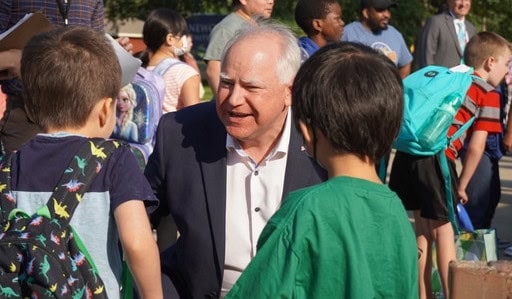
Walz and kids. At a summer event. Image: Governor’s office
Verbatim
Walz: “As a former teacher, coach, and parent, I have made it my mission to make Minnesota the best state in the country for kids to grow up. We have a historic opportunity to take bold action to deliver for Minnesotans, and we’re putting forward a budget that meets the moment. For a middle-class family with young kids, this budget would cut the cost of child care by thousands. For kids across the state, it will reduce their chances of living in poverty. And for our students, it will provide the single-largest infusion of state funding in history, allowing them to provide every student, in every neighborhood, a world-class education.”
Nitty-gritty of what Walz calls “bold plan”
> Child care. As much as $4,000 a year in tax credits for child care for families making less than $200,000. Families with two children, $8,000. Families with three children, $10,500.
> Kids in poverty. Tax credits for low-income families of $1,000 to $3,000 per child. This. Walz said, would cut child poverty 25%.
> School funding. Linking school funding to inflation starting in 2026, to ensure funding for schools keeps up with costs. Also a 4% increase to the formula for state school funding next year and 2% the year after.
> Special ed. Reducing local costs for special education 50%.
> School support staffing. Adress shortage of social, emotional and physical health programs in schools.