
ST. PAUL, Minn. — A court-appointed panel to adjust Minnesota’s congressional and legislative district boundaries to reflect the 2020 census has made few changes. The First Congressional District, which stretches across southern Minnesota, is intact. It includes Winona, Rochester, Owatonna, Albert Lea, Austin, Mankato, New Um and Worthington. Base of new census data, each district has 713,000 residents. The new districts average 93% of the core population in the 2012 redistricting. Notable changes in the congressional map:
> 1st District (Jim Hagedorn-R-Blue Earth): This farm-dominated district gained rural Goodhue and Wabasha counties. Lost LeSueur County and area around Northfield
> 2nd District (Angie Craig, D-Eagan): This south suburban district became more suburban, gaining additional sections of south Washington County. Also gained LeSueur County and more areas around Northfield.
> 3rd District (Dean Phillips. D-Deep Haven): Onky minor adjustments in this western suburban district.
> 4th District (Betty McCollum, D-South St. Paul): This St.Paul-based district lost eastern Washington County.
> 5th District (Ilhan Imar, D-Minneapolis): Only minor neighborhood adjustments.
> 6th District (Tom Emmer R-Delano): The St. Cloud-centric district gained northeast Washington County
> 7th District (Michelle Fischbach, R-Willmar): This central Minnesota district gained Morrison County and more of Stearns County.
> 8th District (Pete Stauber, R-Hermantown): This sprawling district to the Canada birder gained parts of eastern Washington County.
The new boundaries are effective until the 2030 census puts them n flux again. The redistricting was done by a five-member panel appointed by the state Supreme Court. The changes are effective for elections in November.
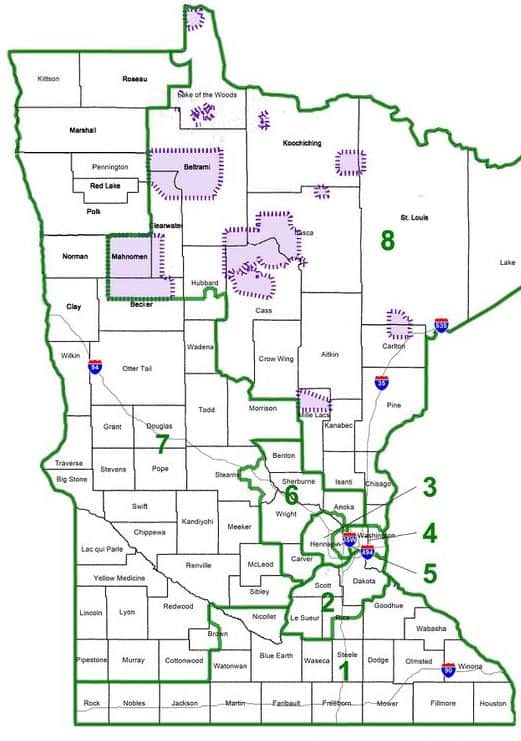
Look familiar? Only modest adjustments in Minnesota Congressional election map since 2010. County lines are black. Congressional boundaries are orange. Tribal nations are lavender. Interstate highway routes show with red, white and blue shields.
Analysis
The redistricting doesn’t pair any incumbents against each other. It short, it doesn’t move any incumbent’s place f residence to another district.
Twin Cities status quo
St. Paul and Minneapolis and St. Paul keep their separate congressional districts.
Race and ethnicity
Minnesota’s population grew by 7.6% between 2010 and 2020 due to increases people of color, mostly blacks and indigenous people. These grous comprise nearly a quarter of the population statewide.
How we got here
Redistricting is constitutionally the responsibility of state legislatures, but the Minnesota Legislature has a record of deferring to the state Supreme Court to avoid political bickering and gerrymandering. The court appoints a panel to do the job. The Legislature could challenge the new congressional map, as well as the new legislative map, but such is not expected.
One-person, one vote
The U.S. Supreme Court’s one-person, one-vote principle for congressional districts guided the redistricting. The 2020 census showed three mostly rural districts lost population over the previous decade five urban and suburban districts grew. To even out each district at 713,000 people, the land mass of rural districts expanded and the land mass of urban-suburban districts contracted.
Verbatim
Redistricting panel: “We are not positioned to draw entirely new legislative districts, as the legislature could choose to do. Rather we start with the existing districts, changing them as necessary to remedy the constitutional defects by applying politically neutral redistricting principles. Still this restrained approach does not necessarily yield little change. When one district changes, so must its neighbors — a cascading effect that means even a district drawn 10 years ago that remains with appropriate population deviation will need to change along with the rest of the state.”
Panel members
>Louise Bjorkman, state Court of Appeals judge.
> Diane Bratvold, state Court of Appeals judge.
> Jay Carlson, 7th Judicial District judge (Becker County).
> Juanita Freeman, 10th Judicial District judge (Washington County).
> Jodi Williamson, 3rd Judicial District judge (Dodge County).