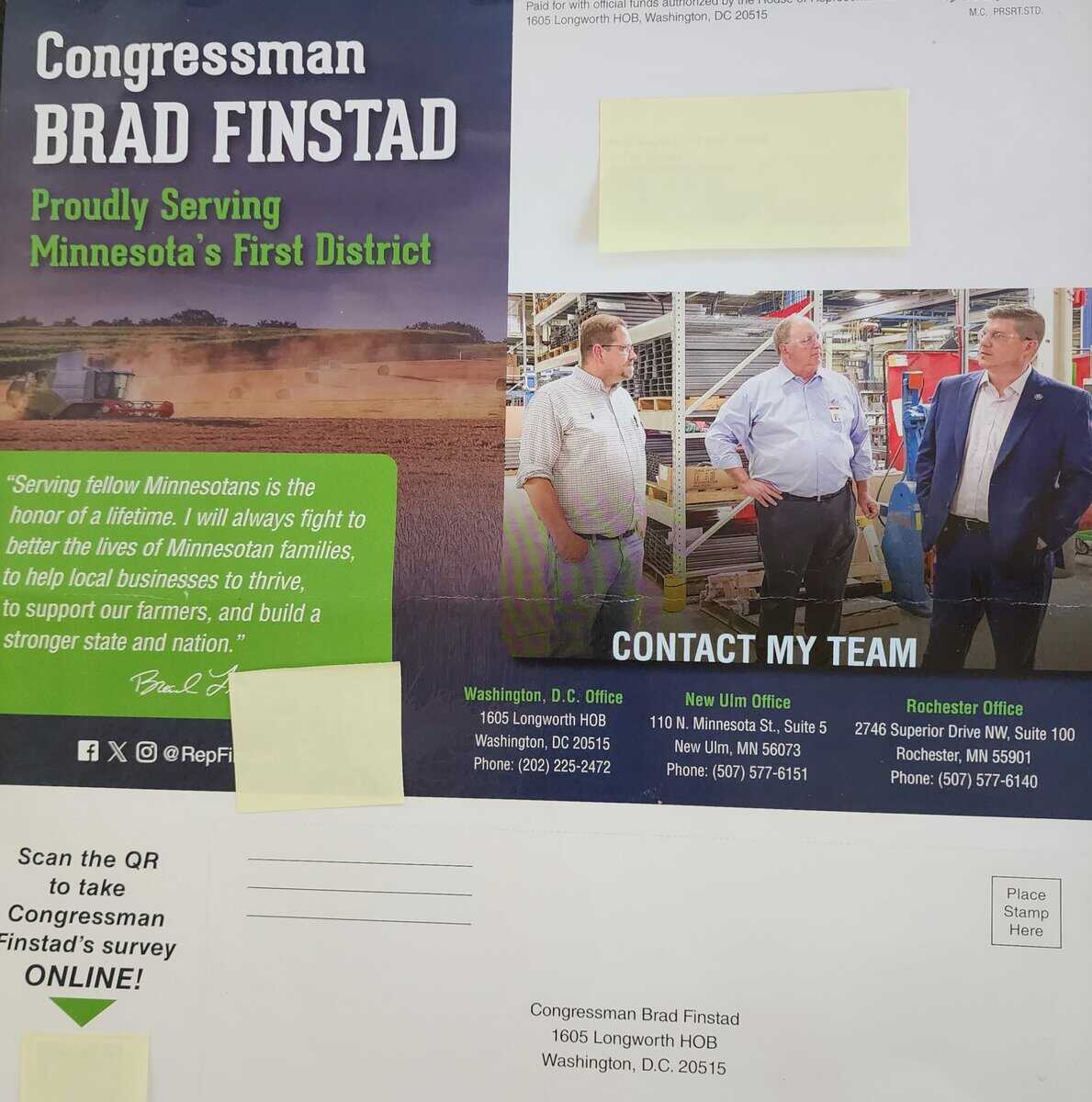
WASHINGTON – Congressman Brad Finstad has blanketed southern Minnesota mailboxes with a slick four-color flyer under the guise of constituent communication but which actually is a slightly veiled campaign advertisement. The flyer was designed, printed and mailed at government expense under what’s called “franking privileges.” Law specifically forbids franking for overt political purposes as unfair to challenger who don’t have free mailing privileges and who must raise their own funds for flyers. Even so, it’s not unfair for members of Congress to skirt the law with flyers that mix legitimate constituent updates and political pitches. Ethicists decry the practice, but it persists. Overall, House members divvy up $18.4 million a year for franked mall.
Finstad’s first term record
As a freshman member of Congress, Finstad has few accomplishments to tout. He has introduced 18 bills – a relatively small number. None has cleared committee, let alone become law. A careful reading of the flyer yields theb message that he’s fighting what he hopes constituents will see as the good fight.
> Finstad reports he favors recovering unspent CoVid appropriations to fund federal budget deficits. The bill hasn’t gone anywhere.
> Finstad reports favoring limits in federal environmental “over-each” that he says disadvantages farmers. The bill hasn’t gone anywhere.
> Finstad reports favoring action against fraud in CoVid programs for child nutrition, but these abuses already are being prosecuted by the U.S. Justice Department.
> Finstad reports sponsoring a bill for a military veterans service center in Mankato. The bill hasn’t gone anywhere.
Finstad’s constituent service
In the flyer Finstad reported responding to 60,793 constituent messages – about 150 a day. This is not an unusual number for a member of Congress with 782,000 constituents and 11 staff members. Also: Many messages are routine. How many cases did Finstad closed? He says 503.

The franking loophole. The practice bears the name of Benjamin Franklin. As the first U.S. postmaster general, Franklin thought that members of Congress should be spared postal charges for their “official business.’” To address abuses over the years, the law has been updated several times to narrow the definition of “official business.”