
WINONA, Minn. – Firefighters suppressed a smoldering fire inside a dust-collector grain bin at the towering Bay State Milling elevator complex on the riverfront just east of downtown. The fire posed a danger of spontaneous combustion from heat-generating dust in the bin. In fact, the 911 caller for help from Nay State said it was a “possible dust explosion.” This was about 8 p.m. Firefighters used long hoses at the top of a Bay State building to contain the fire storage bin from above. There were no injuries.
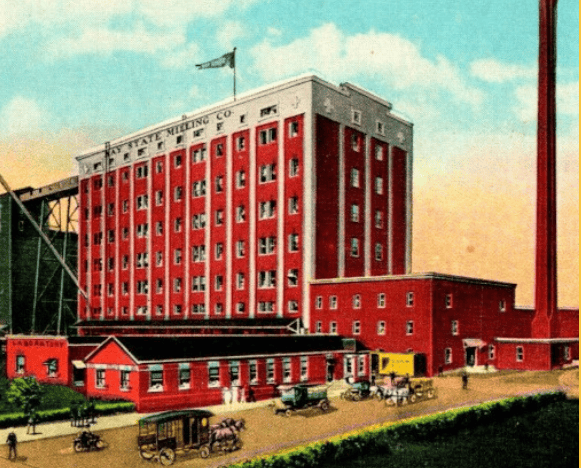
Riverfront landmark. This 1930s postcard has Model As and horse0drawn wagons in and out. Even un the 1930s, the facility is one Winona’s largest industrial complexes.

On Second Street. At foot of Franklin Street. The danger was that a growing concentration of flour dust inside a grain bin, already smoldering, could burst into spontaneous combustion. Flour mills have a history of massive explosions – the larger the mill, the larger the potential explosion. Image: Winona Fire Department
Bay State profile
The family-owned company, based in Quincy, Massachusetts, is 125 years old. It has mills in 10 states and provinces. Annual revenue: $155 million. Bay State produces a broad range of traditional and gluten-free flours, grains, seeds, mixes, and blends. The Winona mill specializes in wheat and rye flour. Products include Health-Sense high-fiber wheat and SowNaked high protein oats.The company has 460 employees systemwide. The Winona manager, Dustin Sanborn, has been with Bay State six years. Earlier he was with General Mills for Bisquick production in Kansas City.
1878 Washburn Mill tragedy
The danger of grain dust in a confined space was inscribed indelibly in Midwest memories by the Washburn Mill explosion in Minneapolis in 1878. Debris was blown hundreds of feet into the air by what’s known as the Great Mill Disaster. The ruins now are a National Historic Landmark. The Washburn mill, then the largest mill in the world, had been opened four years ealier by LaCrosse businessman Cadwallader Washburn. About 6 p.m. on May 2, 1878, the 14-man night shift staff had arrived. An hour later three large explosions occurred. Large chunks of granite came down as far as eight blocks away. The explosions were likened to an earthquake. A massive fire spread to two adjacent mills, which exploded and killed another four millworkers. Intense heat kept firefighters at a dostance. In total, six mills were destroyed. The combustibility of flour dust was confirmed by investigators who concuded that two millstonestone grinders had rubbed against each other and caused a spark that ignited the dust.

Death toll. Eighteen millworkers in all. Image: Contemporary illustration